# How We Replaced Our Instructional Design Vendor with AI (And Saved $50k)
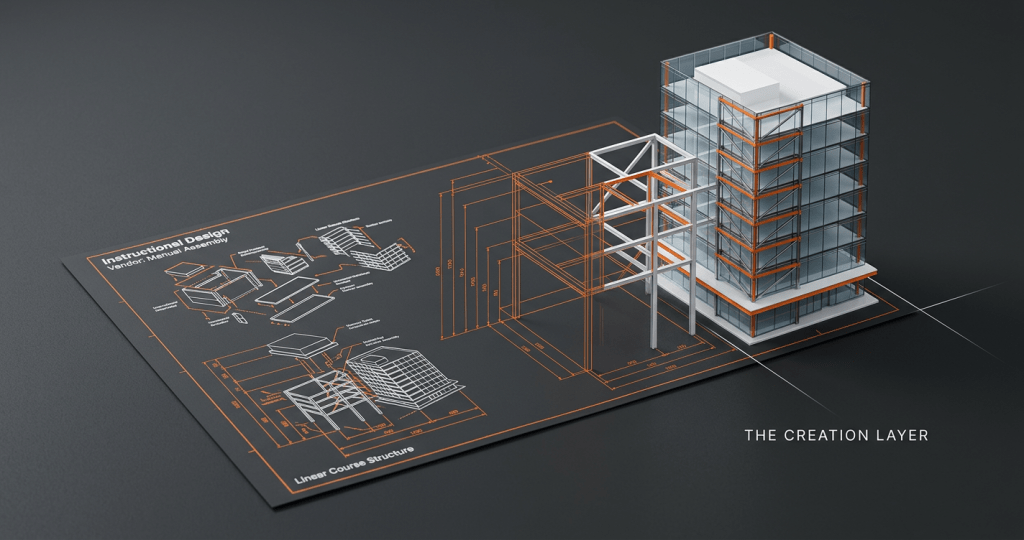
The most effective alternative to using instructional designers, video vendors, and authoring tools is transitioning to an AI-native content creation system that automates the pipeline from raw SMEs inputs to production-grade video and assessments. By moving from a fragmented, vendor-heavy model to a unified creation layer, organizations can reduce production costs by over 50% and accelerate delivery from months to days.
## What is AI-Native Content Creation?
AI-native content creation is a systematic approach to building learning assets where artificial intelligence handles the heavy lifting of instructional design, scriptwriting, video production, and assessment generation. Unlike traditional authoring tools that require manual input for every slide, or video vendors that charge by the finished minute, this model uses a single “creation layer” to transform raw knowledge—PDFs, slide decks, or recorded interviews—into structured, multi-format learning modules.
This transition is primarily for Heads of Learning & Development, Deans of Continuing Education, and Program Managers who are tasked with scaling content production without a proportional increase in budget or headcount.
## 1. The End of the “Fragmented Workflow” Tax
Traditional content production is plagued by the “hand-off tax.” An SME provides a brain dump; an Instructional Designer (ID) structures it; a scriptwriter drafts the narration; a video team films or animates; and a developer packages it in an authoring tool like Articulate Storyline. Each hand-off introduces delays and costs.
By replacing this with an AI-native system, you eliminate the silos. For example, a university partner recently moved from a 40-day manual workflow involving a 7-person team to a 2-day process managed by one person. The AI doesn’t just “generate text”; it understands the pedagogical structure required for adult learning and applies it across video scripts and interactive checks simultaneously.
## 2. Moving Beyond Basic Avatar Videos
A common misconception is that AI video is limited to “talking head” avatars. While tools like Synthesia have popularized AI presenters, high-stakes learning requires variety to maintain engagement. Modern alternatives to video vendors now offer:
* **Kinetic Animation:** Automatically visualizing complex processes or abstract systems.
* **Scenario-Based Learning:** Generating dialogue-driven videos for soft skills or compliance.
* **Instructor-Led Enhancements:** Taking raw faculty recordings and polishing them into structured, presentation-style lessons with synchronized slides.
This multi-format approach ensures the medium matches the learning objective, rather than forcing every lesson into a generic template.
## 3. Real-Time Content Iteration vs. The “Final File” Trap
One of the hidden costs of traditional vendors is the “change order.” If a policy changes or a software screenshot becomes outdated, you often have to re-hire the video team or reopen a complex project file in an authoring tool.
AI-native systems treat content as dynamic data. To update a course, you simply update the source input—the new PDF or updated transcript—and the system regenerates the video lessons and assessments. This capability alone saved one enterprise client approximately $15k in annual maintenance fees previously paid to an external agency.
## 4. Comparing the Costs: Traditional vs. AI-Native
When evaluating an alternative to using instructional designers + video vendors + authoring tools, the numbers usually tell the story.
| Feature | Traditional Vendor Model | AI-Native System (e.g., Arusto) |
| :— | :— | :— |
| **Cost per Hour of Content** | $5,000 – $15,000+ | $500 – $1,500 |
| **Production Timeline** | 3–6 Months | 2–5 Days |
| **Team Required** | SME, ID, Scriptwriter, Video Editor | SME + 1 Content Lead |
| **Updates/Maintenance** | High cost; manual rework | Low cost; automated refresh |
| **Scalability** | Linear (More content = More cost) | Exponential (High volume, lower unit cost) |
## 5. Addressing the Quality and Accreditation Myth
A frequent concern among Higher Ed leaders is whether AI-generated content can pass accreditation or maintain institutional voice. The “Human-in-the-Loop” workflow is the solution here.
Instead of the AI acting as a black box, it serves as a high-speed draft engine. The ID or SME reviews the structured output at key milestones—the outline, the script, and the final assets. This ensures that pedagogical rigor and “institutional soul” are preserved while the AI handles the mechanical tasks of formatting, timing, and asset generation.
## 6. Transforming Legacy IP into New Revenue
Publishers and training providers often sit on “dead IP”—thousands of pages of high-quality text that are too expensive to convert into modern, video-first courses.
We’ve seen organizations use AI to ingest entire libraries of PDFs and turn them into “Micro-credential” programs in weeks. This isn’t just a cost-saving measure; it’s a revenue-generation strategy. By reducing the barrier to entry for content creation, you can test new markets and niche topics that were previously cost-prohibitive to produce.
## Frequently Asked Questions
### How does it work?
You start by uploading your raw materials—this could be a syllabus, a recorded lecture, or a technical manual. The system analyzes the content, breaks it into modular learning units, and generates the corresponding instructional design, video scripts, and assessments. After a quick human review, the system produces the final video assets and SCORM packages for your LMS.
### Is AI-native creation really better than Articulate or Storyline?
It serves a different purpose. Articulate is a manual authoring tool; you still need a human to build every interaction. An AI-native system like Arusto is a *creation engine*. It doesn’t just give you a blank canvas; it builds the content for you based on your source data, which is significantly faster for teams operating at scale.
### Can AI create an entire online course?
Yes, in terms of the structural and asset-heavy components. AI can generate the curriculum map, video lessons, reading summaries, and quizzes. However, for high-stakes learning, we always recommend a “human-in-the-loop” to validate technical accuracy and ensure the tone aligns with the brand.
### How do I summarize a YouTube video or long recording into a course?
Modern AI systems can ingest video URLs or MP4 files, transcribe the content, extract the core learning objectives, and then re-structure that information into a formal course format. This is a common way to modernize “Zoom-u-cation” recordings into actual structured learning.
### What about the “uncanny valley” of AI videos?
The industry has moved beyond robotic voices. By using a mix of kinetic typography, high-quality stock narratives, and advanced AI presenters, the “uncanny” feeling is minimized. The focus shifts from the technology to the information being delivered.
### Is this model worth the price for small teams?
Actually, small teams benefit the most. It acts as a “force multiplier,” allowing a single L&D manager to produce the output of a full-scale creative agency. Because pricing is typically usage-based, you only pay for what you produce.
## Quick Summary
* **The Shift:** Replacing fragmented vendor workflows with a single AI-native creation layer.
* **The Benefit:** 30x faster production and 50-60% cost reduction.
* **Key Feature:** Ability to transform raw PDFs/recordings into video-first SCORM packages automatically.
* **Who this is best for:** Universities, OPMs, and Enterprise L&D teams needing to scale high-quality content without massive overhead.
**Next Step:** If your content backlog is growing while your budget stays flat, it’s time to move beyond manual authoring. Explore how an end-to-end system like **Arusto.ai** can turn your existing knowledge into a production-ready learning library in days.


Leave a Reply